
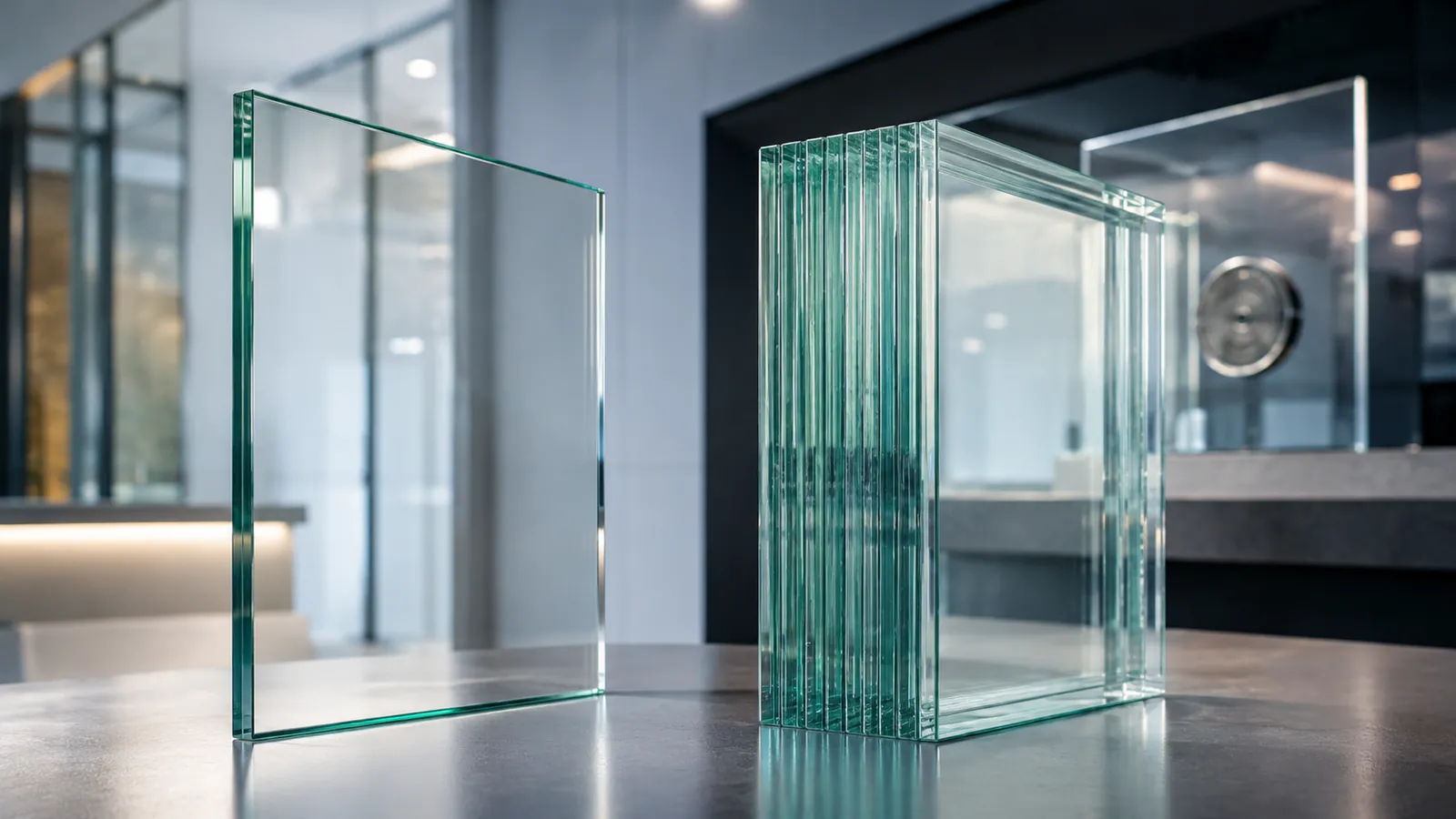
Tempered glass and ballistic glass are both stronger than ordinary annealed glass, but they are designed for very different purposes. Tempered glass is mainly used as safety glass in buildings, furniture, shower enclosures, doors, railings, and partitions. Ballistic glass, also called bullet-resistant glass, is engineered to resist firearm impact and high-security threats.
Understanding the difference is important because tempered glass should not be considered bulletproof. For security applications, the glass structure, thickness, interlayer system, and certified resistance level must be selected according to the actual project requirement.
What Is Tempered Glass?
Tempered glass is a type of safety glass produced by heating annealed glass and then cooling it rapidly. This process creates surface compression and internal tension, making the glass stronger than ordinary glass.
When tempered glass breaks, it usually breaks into small granular fragments instead of long sharp shards. This makes it suitable for many architectural and interior applications where human safety is important.
Common Applications of Tempered Glass
Tempered glass is widely used in construction, decoration, and furniture projects. Typical applications include:
- Shower doors and bathroom enclosures
- Glass doors and entrance systems
- Interior glass partitions
- Table tops and furniture glass
- Balustrades and railings when combined with lamination
- Facade and curtain wall applications
- Shopfronts and commercial glazing
What Is Ballistic Glass?
Ballistic glass is a security glazing system designed to resist projectile impact. It is usually made from multiple layers of glass and high-performance polymer interlayers. These layers work together to absorb and disperse impact energy.
Depending on the required protection level, ballistic glass can be much thicker and heavier than ordinary tempered or laminated glass. It is commonly used in banks, embassies, government buildings, police stations, security counters, armored vehicles, and other high-risk locations.
Main Difference Between Tempered Glass and Ballistic Glass
| Item | Tempered Glass | Ballistic Glass |
|---|---|---|
| Main Purpose | Human safety, impact resistance, thermal resistance | Protection against firearm impact and security threats |
| Structure | Single tempered sheet or part of laminated structure | Multi-layer composite glazing system |
| Breakage Behavior | Breaks into small granular fragments | Designed to absorb impact and reduce penetration |
| Bullet Resistance | Not bulletproof | Designed and tested for ballistic resistance |
| Thickness | Usually thinner | Usually much thicker depending on rating |
| Weight | Relatively lighter | Heavier due to multiple layers |
| Cost | More economical | Higher cost due to complex structure and testing |
| Typical Use | Doors, showers, railings, partitions, furniture | Banks, embassies, security counters, armored vehicles |
Is Tempered Glass Bulletproof?
No. Tempered glass is not bulletproof. It is stronger than ordinary annealed glass and is widely used as safety glass, but it is not designed to stop bullets. If a project requires protection against firearms or forced entry, standard tempered glass is not enough.
For security applications, buyers should choose a tested ballistic glass system based on the required threat level, installation condition, frame structure, and local standard.
Is Laminated Glass the Same as Ballistic Glass?
No. Laminated glass and ballistic glass are related but not the same. Ordinary laminated glass is made by bonding two or more glass sheets with an interlayer such as PVB, SGP, or EVA. It helps hold broken glass together and improves safety performance.
Ballistic glass is a specially engineered and tested composite system. It may include multiple glass layers, polycarbonate, and special interlayers to resist projectile impact. Therefore, standard laminated glass should not be described as ballistic glass unless it has been designed and tested for that purpose.
Which Glass Should You Choose?
The right glass depends on the application:
- Shower doors: Tempered glass is commonly used.
- Glass doors: Tempered glass or laminated safety glass may be used.
- Balustrades and railings: Tempered laminated glass is often preferred.
- Skylights and canopies: Laminated glass is usually important for safety.
- Partitions: Tempered glass, laminated glass, or acoustic laminated glass can be selected.
- Security counters: Ballistic glass may be required.
- Government or high-security buildings: Certified bullet-resistant glass should be specified.
Why Standards and Testing Matter
Ballistic glass should not be selected only by thickness. The protection level depends on the full glazing system, including glass layers, interlayers, frame design, installation method, and certified test rating. A thick glass panel without proper structure may still fail under security impact.
For building and security projects, buyers should provide the required protection level, application location, opening size, frame details, and local standard requirements before ordering.
Barrett Limited’s Safety Glass Options
Barrett Limited supplies a range of processed glass products for architectural and safety applications, including tempered glass, laminated glass, tempered laminated glass, insulated glass, and custom processed glass. For projects that require higher security performance, glass structure should be evaluated carefully according to the intended risk level.
Our team can support buyers with glass type selection, thickness options, processing methods, edge finishing, drilling, lamination, packaging, and export supply for construction and architectural projects.
FAQ
Is tempered glass the same as ballistic glass?
No. Tempered glass is safety glass for common architectural use, while ballistic glass is a tested security glazing system designed to resist projectile impact.
Can tempered glass stop a bullet?
No. Tempered glass should not be considered bulletproof.
Is laminated glass bulletproof?
Ordinary laminated glass is not automatically bulletproof. Ballistic glass requires a special multi-layer structure and certified testing.
What glass is best for railings?
Tempered laminated glass is commonly used for railings because it combines strength with post-breakage safety.
What glass is used for high-security buildings?
High-security buildings may require certified bullet-resistant or forced-entry-resistant glazing systems based on the required protection level.